If AI can build software so much faster, how much should a custom app cost now?
It’s a fair question. If you’ve been quoted $100,000 for a platform, or told your idea needs ten engineers and a seven-figure budget, you should be asking what has changed.
My view is that the bigger opportunity is what that same investment can now make possible. A platform that felt out of reach. More of the workflows you actually need. Time to test, improve and get the details right before launch.
By agentic AI, I mean tools that can work through a development task: explore the code, make changes, run tests and iterate, with a developer directing and checking the work.
That opens up a different way of delivering software. An experienced developer can spend more time on the problem, the design and the decisions that matter, while agents take on more of the implementation.
The developer still needs to know what good looks like. But the amount they can get through is changing, and some of the newer evidence is considerably more ambitious than the early coding-assistant studies.
Anthropic’s October 2026 report describes code commits per engineer rising to roughly five times their level six months earlier. It also found a sharp rise in code added after engineers adopted coding agents.
That is a substantial change in output. It measures code activity inside Anthropic, rather than completed customer platforms or project costs. The company also grew rapidly, and employees chose when to adopt agents, so the study cannot attribute the whole increase to AI.
An earlier Anthropic study, published in December 2025, found engineers and researchers reporting an average 50% productivity boost. More interesting to me, 27% of Claude-assisted work was work they said would not otherwise have happened.
That gets much closer to the opportunity for a business. The useful integration you left out. The internal tool nobody had time to build. The improvements that kept getting pushed down the list. More becomes worth doing.
There are bigger claims too. Anthropic’s Headstart customer story reports 10 to 100 times faster software development, including a project delivered in two weeks against a client CTO’s estimate of four to eight months. The story describes experienced engineers focusing on architecture and problem-solving while Claude handles much of the implementation.
I think that is worth paying attention to. It is also a supplier-published customer claim, and that example compares delivery with an estimate. It does not establish that every project can be delivered 10 to 100 times faster.
The published numbers vary enormously because they measure different things:
That is a spread of published results and claims, not a range I can apply to your quote. Tasks, perceived productivity, commits and project timelines are different measurements. None directly tells us how much more finished software your dollar buys.
Results can go the other way too. METR’s February 2026 update discusses an early-2025 experiment where experienced developers took 19% longer with AI. Its later work suggested improvements, but selection effects made the size of the gains unreliable.
For your project, the useful question is where the effort goes. A new application with clear requirements and standard integrations gives agents different work from untangling years of undocumented business rules. Data cleanup, external approvals and difficult product decisions still need attention.
I would rather look at those constraints and give you a credible scope than multiply your budget by a headline number.
Getting more for your money should mean a more useful product. It might mean connecting the systems your team currently updates by hand, covering more of the real workflow, or having time to improve the experience after people try it.
The foundations still matter. I want to build quickly and get those decisions right at the same time. Keep the design practical, test the difficult assumptions early and avoid making the system more complicated than it needs to be.
My work includes Song Maker and Midify, early AI music apps with millions of combined uses, and technical-lead work on Omega Sierra’s freight platform. I bring that engineering and solution-design experience to directing AI development tools, and I remain responsible for the result.
Cheaper implementation doesn’t make every idea a good investment. Sometimes an existing product, a small integration or a simpler process solves the problem better.
That should be part of the first conversation. I’d rather help you avoid an unnecessary project than build it efficiently.
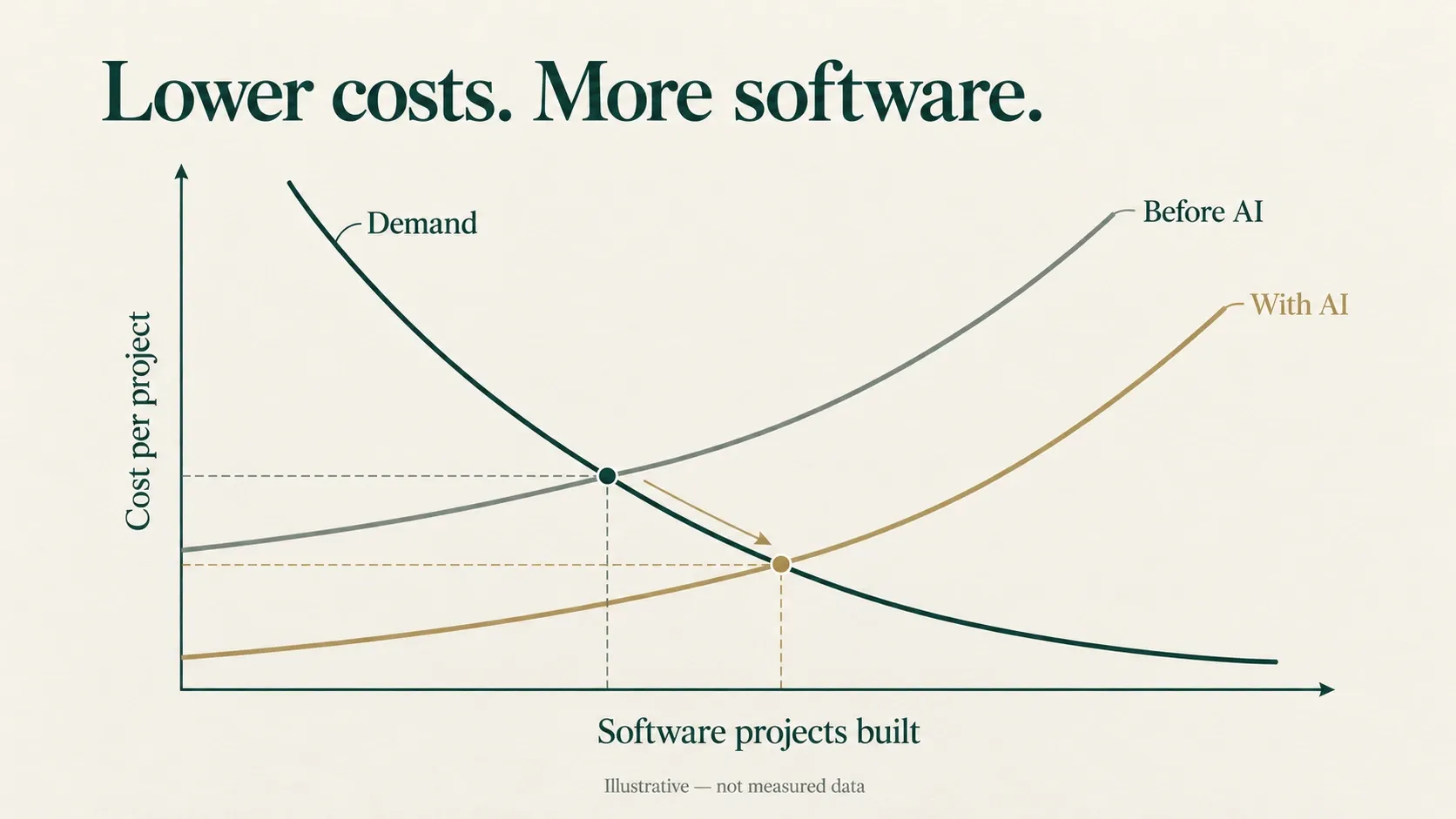
There’s an idea in economics called Jevons’ paradox. Making something more efficient can make it cheap enough to use much more of it, sometimes increasing total resource use. I think there’s a useful parallel with software: as development gets cheaper, more projects start to make sense.
A business might spend less on the platform it originally planned. Or it might use the same budget to also build the integrations, reporting and internal tools it previously couldn’t justify. Across businesses, that could mean more software gets built without total spending falling.
That’s how I’d answer the original question. The cost of building a particular thing can come down. What businesses choose to build can expand. Just because software gets cheaper doesn’t mean less gets spent. It may mean more gets done.
Talk through your project or explore custom app development.
